

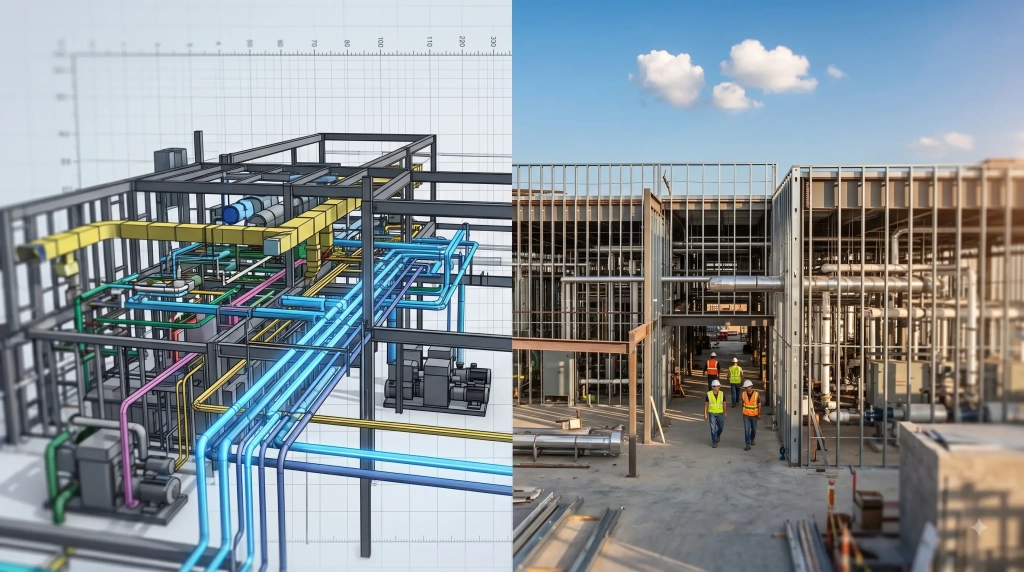
The gap between 3D design and site reality
In theory, a federated model resolves every spatial conflict before a single shovel touches the soil. In practice, the handoff from design teams to trade contractors is where most projects lose their alignment. Subcontractors often work from outdated sheets or make field adjustments without updating the central database. This disconnect turns a minor piping error into a cascade of delays that halts work across multiple trades. If the digital representation of the building is not maintained with absolute discipline, it ceases to be useful during active construction.
To prevent these coordination failures, we must shift how we view LOD 400 models. These are not static reference documents: they are the exact instructions for fabrication and assembly. In our work across various complex builds, we observe that the major friction points occur when structural tolerances conflict with rigid MEP routing. If the structural concrete is off by even fifteen millimeters, a pre-fabricated duct run will not fit. The solution is to enforce rigorous, field-verified inputs during the modeling phase using clash detection services to catch these deviations before fabrication begins. This requires active coordination meetings where trades must resolve conflicts in the model, rather than hoping to solve them on the construction floor.
How the aariha pmc projects portfolio redefines project data coordination
A review of the company’s project records reveals a consistent methodology: the model is treated as the single source of truth for every procurement and scheduling decision. When you integrate schedule data, often called 4D BIM, with the physical asset model, you can visualize the construction sequence day by day. This prevents the typical bottlenecks where structural crews are waiting on anchor bolt installations or MEP trades are blocked by unpoured floor slabs. The model becomes a live schedule, updating in real time as site conditions evolve.
For example, on complex industrial builds, managing the arrival of heavy machinery requires precise timing. If the equipment arrives before the access path is clear, you face staging fees and potential damage. If it arrives too late, the structural steel assembly stalls. By linking the delivery schedule directly to the geometric model, project managers can verify that the physical pathway remains unobstructed. This level of coordination requires a disciplined approach to data management, ensuring that every trade updates their progress in the master model weekly. This systematic tracking eliminates guesswork, allowing owners to monitor progress with complete transparency.
Is 5D cost estimation practical on fast-track projects?
Many developers are skeptical about 5D BIM, which adds cost estimation to the spatial model. The common objection is that fast-track projects move too quickly for cost databases to remain accurate. This skepticism is valid when teams try to automate cost calculations without manual verification. If the model is not set up correctly from the start, the cost outputs will be inaccurate, leading to budget overruns.
The reality is that 5D estimation works when it is limited to major material quantities like concrete, structural steel, and primary piping runs. Trying to model every minor bracket or electrical conduit for cost purposes leads to data bloat. By focusing on the high-cost, long-lead items, project owners can use the model to run rapid scenario analyses when design changes occur. If a structural revision changes the steel tonnage, the model should instantly update the budget forecast, giving the owner immediate clarity instead of waiting weeks for a quantity surveyor’s report.
Can you execute BIM without dedicated field-level coordinators?
Some project owners believe that once a model is coordinated, the site superintendent can handle the execution. This is a common mistake that leads to immediate model degradation. A superintendent is focused on labor management, safety, and daily progress. They do not have the time to open a complex model on a tablet to verify if a pipe is being hung at the exact elevation specified.
Without dedicated coordinators on site, subcontractors will default to traditional methods. They will route their lines through the easiest paths, regardless of what the model says. This creates a chain reaction of conflicts for the next trade, who then finds their designated space occupied. A field coordinator is the bridge between the digital model and the physical installation. Their job is to verify that what is installed matches the coordinated files, and to document any field changes so they can be fed back into the as-built model. This continuous feedback loop is the only way to maintain the integrity of the digital asset.
The primary obstacle to successful digital construction is not the software capability, it is the deeply ingrained habits of field crews who prefer paper drawings over digital coordinates.
In our experience managing industrial project coordination, we have found that setting up digital kiosks on the construction floor is highly effective. These kiosks allow field foremen to access the latest coordinated models without leaving the work area. When access to information is simple, compliance increases. This transition from paper to digital coordinates is a major step toward reducing rework and ensuring that the final handoff is an accurate reflection of the built asset. It empowers the field teams with the same level of detail that the design office possesses, removing the informational barriers that slow down production.
Why upfront design validation minimizes rework
Rework is the single largest driver of budget overruns in complex construction. In traditional projects, rework accounts for a significant portion of the total cost, often caused by late-stage discoveries of physical clashes. The methodology observed in our project delivery framework prioritizes upfront design validation to eliminate these surprises. By investing time in constructability reviews during the pre-construction phase, we can identify design inconsistencies before they turn into expensive field modifications.
By enforcing a strict sign-off process where trades must approve the coordinated model before fabrication begins, the financial responsibility for any subsequent clashes shifts to the non-compliant party. This simple contractual change drives high levels of accuracy in the modeling phase. Subcontractors spend more time verifying their inputs because they know they cannot charge for field modifications if they deviate from the approved model. This structured approach is what makes a project management consultancy indispensable when delivering complex, fast-track assets on time and within budget. It turns the BIM model from a design exhibit into a binding operational agreement.
Managing the fine details of a complex build requires a balance of software expertise and site discipline. If you want to eliminate costly physical clashes and ensure your contractors build to the exact specifications, you need an experienced partner who knows how to enforce model integrity on the ground. Explore how we apply these principles on active jobsites by reviewing the aariha pmc projects portfolio, and contact our team to discuss your next development.
Take Control of Your Project’s Digital Integrity
Don’t let valuable BIM data go to waste on the construction floor. Partner with Aariha Group to bridge the gap between digital design and real-world execution, ensuring absolute model compliance and eliminating costly rework.
Frequently asked questions
What is the difference between 3D coordination and true BIM execution?
3D coordination simply identifies physical conflicts between structural and utility elements in a virtual environment. True execution integration ensures that the coordinated model directly dictates procurement schedules, fabrication dimensions, and daily site installations, preventing field crews from reverting to traditional 2D overrides.
How does 4D scheduling prevent site bottlenecks?
By linking the construction schedule directly to the 3D model geometry, project managers can simulate the assembly sequence. This process identifies logical conflicts (such as sequencing concrete pours before underground utilities are verified) before they halt progress on the jobsite.
Why do contractors often resist using digital models on site?
Resistance usually stems from a lack of digital access on the construction floor and deeply ingrained habits of relying on printed paper drawings. Providing accessible mobile workstations and conducting active model-based coordination meetings helps bridge this gap.
What level of detail is required for effective clash detection?
Effective spatial coordination requires an LOD 400 model, which includes accurate fabrication dimensions and specific component data. Lower levels of detail lack the precision needed to pre-fabricate materials with confidence, leading to field modifications.
How does a PMC enforce model compliance among subcontractors?
Compliance is enforced through clear contractual specifications that make the coordinated model the sole source of truth. Subcontractors are held financially responsible for any rework caused by deviations from the approved digital files, which encourages strict adherence to the model.